

Clear aligners are only as good as the person planning them. The plastic trays look the same from office to office, but the tooth movements behind them can be designed by a board-certified orthodontist or by a lab technician working for a dentist who took a weekend course.
Drs. Bob and Juliana Miller have treated patients with clear aligners since 1999, and Miller Orthodontics has completed more than 3,000 aligner cases across two aligner systems, Invisalign and uLab. Here are the 10 questions we’d want answered before trusting anyone, including us, with your smile.
1. Is my provider an orthodontist or a general dentist?
This is the biggest difference, and most patients never ask. An orthodontist completes dental school and then 2–3 more years of full-time residency training in tooth movement, jaw growth and bite correction. Only then can they use the title “orthodontist.”
Most aligner providers are general dentists. They can offer aligners after attending weekend courses, and some of those courses award “certificates of achievement,” but none come close to the rigor of a specialty residency.
Many general-dentist aligner cases are limited treatment, where a lab technician guides the tooth movement. Lab fees are tied to provider volume and tier, so a patient can pay as much or more for a plan no doctor designed. At Miller Orthodontics, our doctors set up every digital workflow themselves. We combine facial growth and development, growth guidance and bite (occlusion) to choose the most efficient way to move each tooth.
2. Are they board certified?
Board certification is the next filter after the orthodontist title. To become a diplomate of the American Board of Orthodontics (ABO), an orthodontist passes a written exam and then a clinical exam reviewing their actual treated cases. Certification lasts 10 years, after which the orthodontist must recertify to keep it. The American Board of Orthodontics is the only advanced certification process recognized by The American Dental Association.
Dr. Miller has been ABO board certified since 1992 and recertified in 2008, which earned him lifetime ABO status. He is also a member of the Angle Society, an advanced certification achieved by roughly 5% of U.S.-trained orthodontists.
What you can do: look up any provider in the ABO’s online directory of board-certified orthodontists before your consultation.

3. Who actually designs my treatment plan?
Every aligner starts as a digital plan: software moves your teeth on screen, stage by stage, before a single tray is made. The software proposes a plan, but someone has to decide whether that plan is right for your bite, your roots and your face.
Miller Orthodontics runs three digital workflows: Invisalign aligners, Lightforce 3D-printed braces and InSmile lingual braces. All three require digital tooth alignment before the appliance is made. Our doctors review every one of those plans, and almost every patient’s plan gets custom changes before fabrication.
Ask your provider directly: “Do you design my plan yourself, or do you approve what the lab sends?”
4. What happens if aligners stop working for me?
Most of our cases finish with a smile and a bite that meet our treatment objectives. In rare cases, we switch methods partway through, usually because of limited compliance, repeated breakage, an allergy, or a patient who simply doesn’t tolerate the appliance well. Yes, we’ve had a patient allergic to the plastic Invisalign tray!
A practice that offers several systems can make that switch without starting over somewhere else. An aligner-only office has one tool. Ask what the backup plan is before you start.
5. Does a Platinum or Diamond Invisalign badge mean they’re better?
Not necessarily. Tier promotion is marketing. Invisalign tiers are based on how many cases a provider starts, not on how well those cases finish.
A better question is whether a high tier reflects one method the company is pushing, or whether the provider has mastered several. Miller Orthodontics has treated more than 3,000 cases using two aligner systems, and Invisalign is one of them. We pick the system that fits the patient, not the one that keeps a badge.
6. Will they tell me if aligners aren’t the best option?
A good provider tells you when aligners aren’t the right tool. We can offer Invisalign to most of our patients. But complex movements, such as impacted canines or cases that need jaw surgery, are generally treated more efficiently with braces.
For more difficult cases, Lightforce 3D-printed braces give us more control. When esthetics matter most, InSmile lingual braces sit behind the teeth, where no one sees them. Be cautious of anyone who says aligners can fix everything. (See Braces vs. Invisalign.)
7. What records do they take before treatment?
A healthy smile and a predictable result start with a full diagnosis. Before we plan any aligner case, we take:
- A 3D digital scan of the teeth
- Panoramic and cephalometric x-rays, which show the roots, jaws and how they relate
- Facial and intraoral photos
- A bite (occlusion) evaluation
- A CBCT 3D scan when needed, a valuable addition for cases like impacted teeth
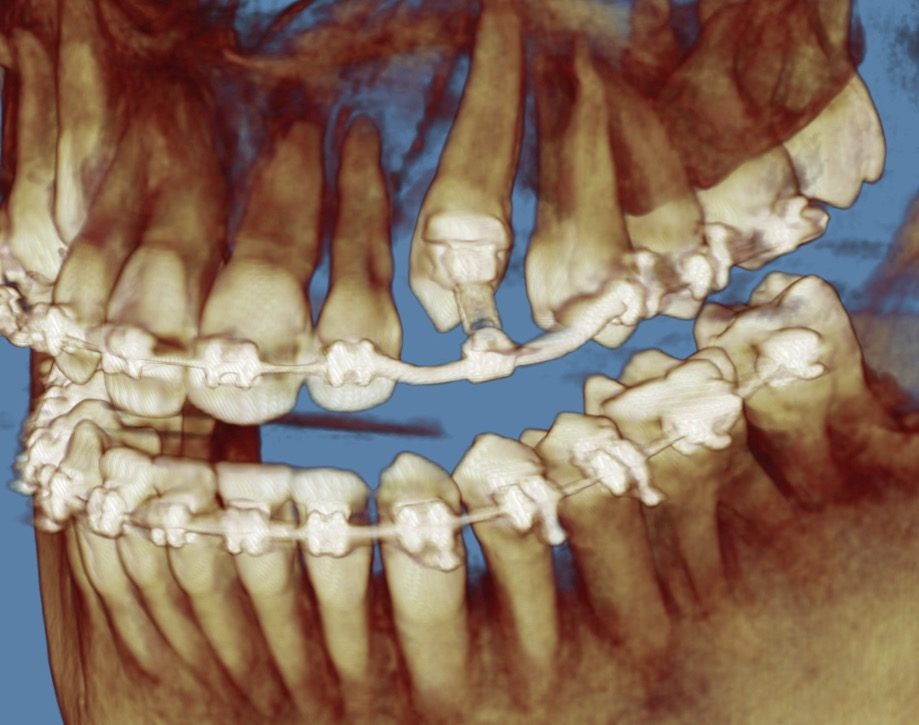
If a provider plans treatment from a scan alone, they are moving teeth without seeing the roots and jaws underneath.
8. How closely will they supervise my treatment?
Remote dental monitoring has improved supervision. Patients send scans from home between visits, so we see aligner patients in the office about every 6–10 weeks instead of more often. That combines doctor oversight with fewer trips to the office.
Mail-order and DIY aligners remove the doctor almost entirely. Dr. Miller has seen his share of DIY patients and has yet to see a DIY case he would consider finished. Making the aligners is itself a highly technical process: if the impression or scan isn’t accurate, the aligners won’t fit, and teeth won’t move as planned.
9. How many refinements should I expect?
One refinement is typical when the initial setup stages the movements correctly and avoids interferences between teeth. That depends on understanding aligner biomechanics, which differ from the mechanics of braces. A provider trained only in one, or neither, will plan around those differences less well.
If you’re on your third or fourth round of refinements, ask why. Also keep in mind that straighter isn’t the same as finished. A finished case means the bite fits together, the roots are positioned correctly and the result is stable, not just front teeth that look straight in photos.
10. What should I ask at my consultation?
Start with three questions:
- Which aligner system do you use, and why? There are many good options today, and all of them have merit. What matters is whether the provider can explain why a system fits your case.
- How long have you been using aligners? Experience shows in the setup, and Dr. Miller has used aligners since 1999.
- What specific training makes you qualified? Listen for a residency and board certification, not only a weekend course.
Use this checklist to compare providers:
| Question | What a strong answer sounds like |
|---|---|
| Orthodontist or general dentist? | Orthodontist with 2–3 years of residency training |
| Board certified? | Yes, ABO diplomate (check the ABO directory) |
| Who designs the plan? | The doctor, with custom changes before fabrication |
| Systems offered | Several, so they can switch methods if needed |
| Records taken | Scan, x-rays, photos, bite exam, CBCT when needed |
| Supervision | Remote monitoring plus office visits every 6–10 weeks |
| Refinements expected | Usually one |
| Years with aligners | Many years and a large number of finished cases |
The bottom line
The aligner brand matters far less than the training, judgment and experience of the person planning your treatment. Choose a board-certified orthodontist who designs your plan personally, takes complete records, offers more than one way to move teeth and is honest when aligners aren’t the best fit.
Miller Orthodontics has two full-time, fully equipped offices: Kimball Junction in Park City and Main Street in Heber City. Schedule a consultation, and ask us every question on this list. For fees and financing, see How Much Do Braces Cost?